How Many Composite Numbers Are There from 1 to 100?
What are Composite Numbers?
When it comes to numbers, we often categorize them into different types, such as prime numbers, composite numbers, and more. In this article, we'll focus on composite numbers, which are positive integers that have at least one positive divisor other than one or the number itself. In other words, a composite number is any positive integer greater than one that is not a prime number.
Composite numbers play a significant role in mathematics, particularly in number theory. They are used to describe the building blocks of numbers and are essential in various mathematical operations, such as multiplication and division. To understand how many composite numbers exist between 1 and 100, we need to first identify what composite numbers are and how they are different from prime numbers.
Counting Composite Numbers from 1 to 100
What are Composite Numbers? Composite numbers are the opposite of prime numbers. While prime numbers have only two distinct factors (1 and the number itself), composite numbers have more than two factors. For example, the number 6 is a composite number because it can be divided by 1, 2, 3, and 6. On the other hand, the number 5 is a prime number because it can only be divided by 1 and 5.
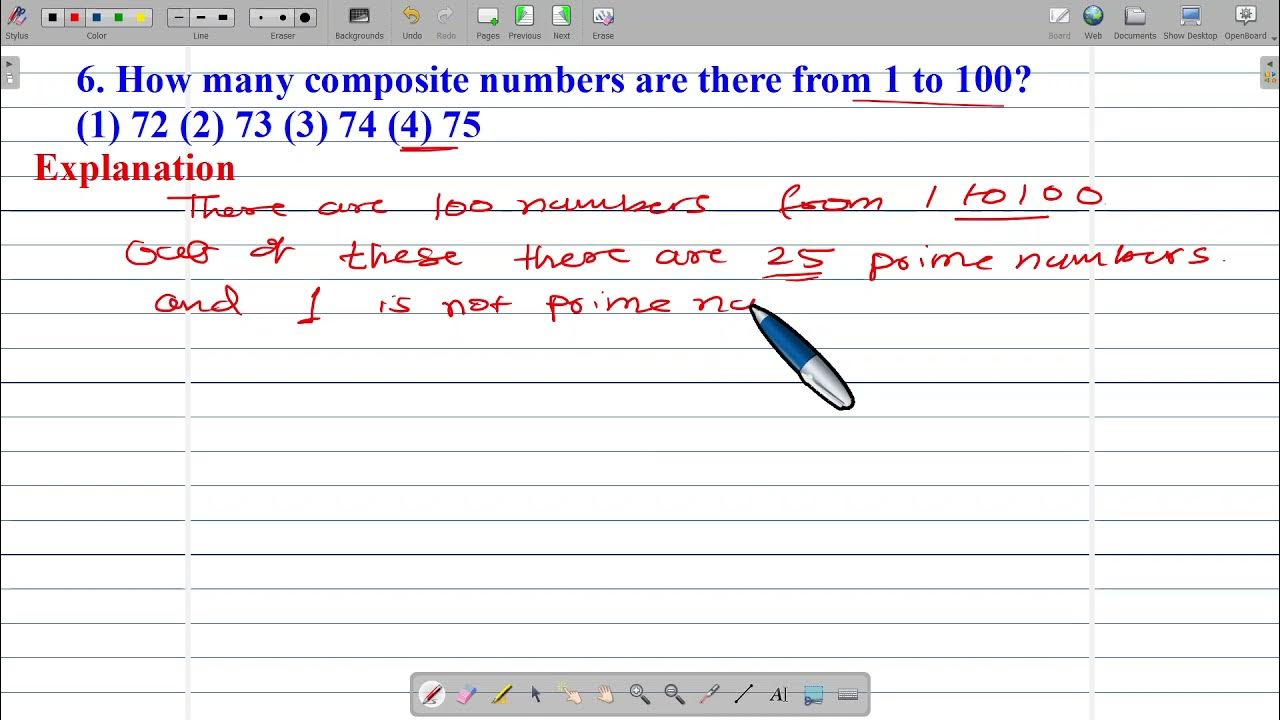
Counting Composite Numbers from 1 to 100 To count the number of composite numbers from 1 to 100, we can start by identifying the prime numbers in this range and then subtracting them from the total count of numbers. There are 25 prime numbers between 1 and 100. Since there are 100 numbers in total, and 1 is neither prime nor composite, we can calculate the number of composite numbers by subtracting the number of prime numbers and 1 from the total count. Therefore, there are 100 - 25 - 1 = 74 composite numbers between 1 and 100.